
The last mow of the year in Kansas City usually happens without anyone noticing it was the last one. The leaves stop, the grass goes dormant, and the mower gets pushed into the corner of the garage with half a tank of gas and a deck caked with clippings. Come April, it won’t start.
Learning how to store a lawn mower for winter takes about an hour this month. Here’s what the engine and mower makers actually recommend, plus where the mower should sit in the garage so it’s out of your way until spring.
Start with the gas
Fuel is the main reason mowers won’t start after winter. Briggs & Stratton notes that gasoline can start to degrade in as little as 30 days, and moisture that condenses in a partly empty tank can cause rust and clog the carburetor. You have two options, and the right one depends on what you own.
Small walk-behind mowers: run it empty
Toro’s winterizing guide recommends emptying the fuel on walk-behind mowers. Already past your last mow? Run the engine until it stalls. Next year, stop topping off the tank in October and let the last few mows burn it down.
Riding and zero-turn mowers: stabilize and fill
For larger mowers, Toro recommends the opposite. Add a fuel stabilizer made for winter storage to fresh gas and top off the tank. A full tank also leaves less room for air, which means less condensation. After you add the stabilizer, run the engine for a few minutes so the treated fuel gets through the fuel system.
Not every maker agrees. Briggs & Stratton and Cub Cadet recommend stabilized fuel instead, and Exmark allows either approach, so the manual for your model breaks the tie.
Clean the deck before it hardens
Wet clippings packed under the deck hold moisture against the steel all winter. Clean them out now while they still scrape off.
- Disconnect the spark plug wire first. That keeps the engine from turning over while your hands are near the blade.
- Scrape and rinse the underside. A plastic putty knife and a hose take care of most of it. Let it dry fully before the mower goes back in.
- Look at the blade. If it’s dull or nicked, winter is the easiest time to sharpen or replace it.
- Wipe down the engine. Brushing off dried grass and dirt makes it easier to spot oil leaks and loose parts.
Do the engine maintenance now, not in April
Exmark’s advice is to schedule this right after your final mow of the season. Don’t leave it for spring. The usual list:
- Oil. Briggs & Stratton recommends draining the old oil and refilling with fresh. Toro points out that some engines aren’t designed to need oil changes, so check the manual. Used motor oil can’t go in the trash. Set it aside in a sealed container for a hazardous waste drop-off.
- Air filter. Clean it or replace it if it’s dirty.
- Spark plug. Replace it if it looks worn or fouled.
It just tends to get skipped when it’s 40 degrees and the mower is already in the garage.
Riding mowers: take care of the battery
A battery left connected in a cold garage all winter can be dead by spring. You have two good options:
- Pull it. Disconnect the negative cable first, then the positive, and clean the terminals. Store the battery somewhere cool and dry, away from gas cans, water heaters, and furnaces. Charge it fully before you reinstall it in spring.
- Leave it in and keep it charged. Exmark lists recharging through the winter as an option. If you plan to start the mower every month or so, it says leaving the battery in is fine, as long as you fully charge it first.
Where to store a lawn mower for winter in the garage
The manuals cover the engine. They don’t cover your garage, and that’s how a mower ends up blocking the car all winter. A few rules of thumb:
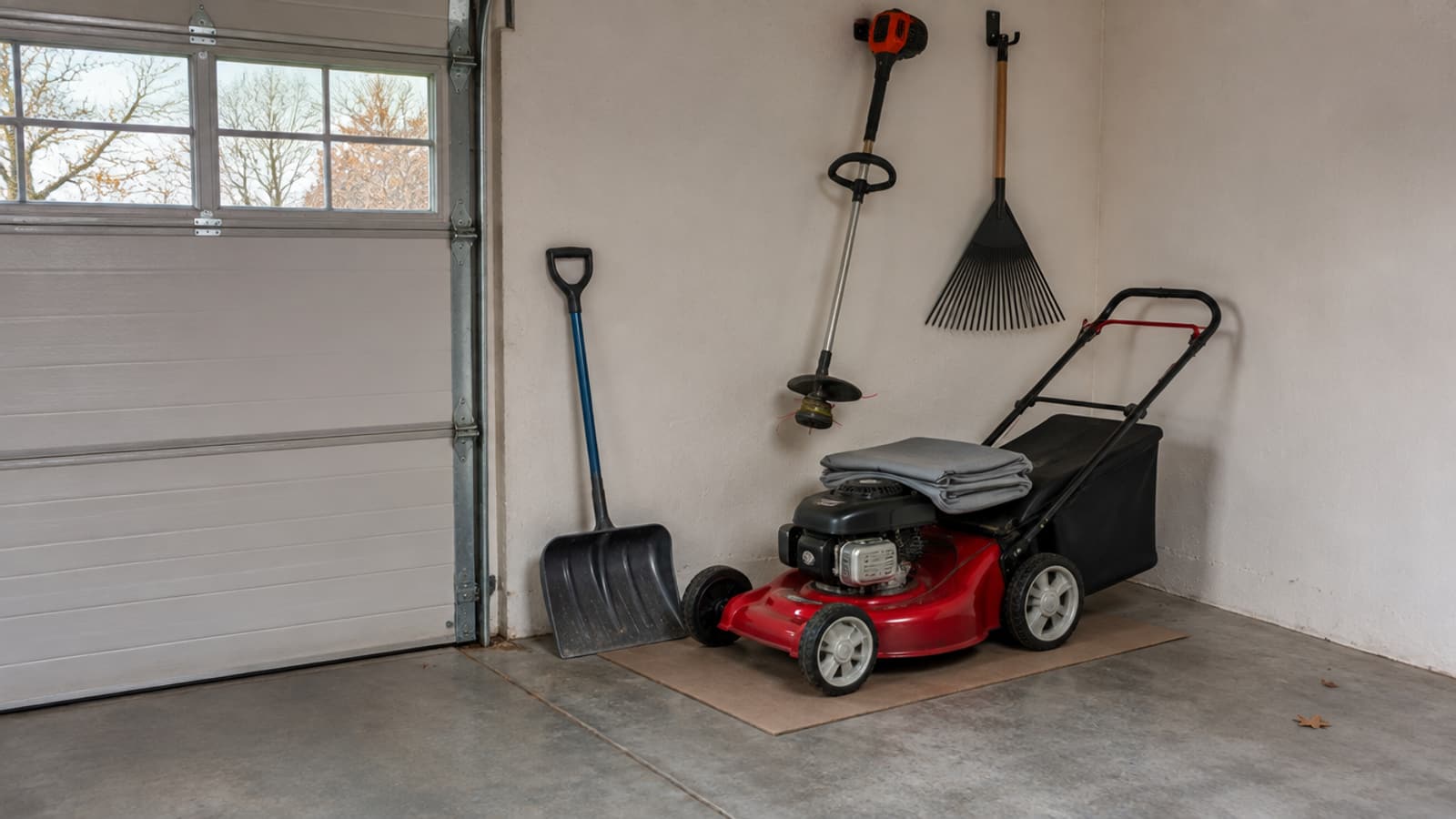
- Put it in the back corner. Once fall cleanup is done, the mower is the least-used thing in the garage until April. It doesn’t need the spot by the door.
- Keep it away from sparks and fertilizer. Exmark and Toro both say to keep stored mowers away from anything that can spark and from fertilizer and other corrosive products. That rules out the spot beside the water heater and right next to the bags of lawn food.
- Get it off bare concrete. Toro and Exmark both suggest parking the mower on cardboard or other insulating material, and Toro adds that the tires should be inflated to the proper pressure.
- Cover it. A breathable mower cover or tarp keeps dust and debris off. Make sure the mower is clean and dry before you cover it.
- Swap it with the winter gear. The snow shovels, ice melt, and windshield scrapers that sat in the back all summer should come forward to where the mower was.
If your garage doesn’t have a back corner left, that’s usually the real problem, not the mower. Lawn and garden is one of the standard zones in our garage organization work, because mowers, trimmers, and fertilizer bags are some of the hardest things to fit. Send us a photo of yours and we’ll tell you what it would take.
A 10-minute spring restart
If you did the work in fall, spring is quick:
- Reinstall the charged battery.
- Make sure the spark plug wire is connected.
- Check the oil level and tire pressure.
- If you ran a walk-behind empty, fill it with fresh gas.
Then swap them back.
When the garage is the bigger problem
Sometimes the mower isn’t the issue. There’s just nowhere to put it. If the back corner is buried under boxes, old furniture, and a couple of broken mowers you meant to deal with years ago, that’s a garage cleanout, not a weekend chore.
If you’d rather not spend your weekends on it, have a crew clear it out and set up a real spot for the lawn equipment. Send us a few photos and request a free estimate. You’ll get a written quote, with no visit to schedule. (We don’t haul gasoline or motor oil, but we’ll tell you where it can go.) We work on the Missouri side of the metro, from Liberty to Lee’s Summit.